Not everyone can pull off authoritative parenting
In the modern world, authoritative parenting yields the best results on virtually every metric - but we should stop pretending it's easy.

As I browsed the ‘Mummy Wars’ section of my local library earlier this week, two volumes caught my eye. John Locke’s ‘Some Thoughts Concerning Education’ (1693) advocated for a child-centred approach to character formation through experiential learning. Locke didn’t actually tag anyone in the post, but I think he was responding to the original primal mama, Jean-Jacques Rousseau, and his 1762 treatise ‘Émile’ which argued children should be left to develop without the corrupting influence of society. A lot of people at the time thought Rousseau was just shitposting to make other mums feel guilty about using car seats. But it got me thinking: is it possible that topics like ‘the development of a healthy body’ and ‘the formation of a virtuous character’ in children and adolescents have always captivated thinkers? Could it be that these topics are only considered a bit frivolous now that they’re primarily explored by actual mothers?
Anyway, here is the promised deep-dive on parenting styles and behaviour management, exploring yet another question which for some reason makes everyone really aggressive: can you really ‘just tell your kids what to do’ or do you need to accept that your ‘strong willed’ child will sometimes refuse to brush their teeth, choosing instead to scream for 20 minutes? I’ll kick off this article by slicing through the modern jargon and taking us back to the original framework of parenting styles, outlining the pros and cons of each style, and explaining why I’m so confident in advocating for ‘authoritative’ parenting. I’ll proceed to infuriate many people by arguing that, yes, it is possible to elicit pretty consistent cooperation from all children and adolescents. But—and this is a very big ‘but’— it is a soft skill which rides on levels of experience, energy, confidence and community support that many modern parents struggle to access. I’ll also suggest some stuff we can all do to be more authoritative in our parenting.
As ever, I wrote this mainly to answer some of my own questions, and I hope it is a useful resource for parents who aren’t 100% sure where to position themselves on the ‘authoritativeness’ spectrum, or those who have a clear vision, but struggle with execution. It will hopefully also be of interest to readers who aren’t currently raising kids, but might occasionally find themselves on a plane, wondering: will the parents eventually tell this kid to shut up or must I listen to his screeching for the next 3 hours? It is a valid question, and one I hope to answer. Let’s get into it!

The sweet embrace of a theoretical framework
My main challenge in cracking this topic was the absolutely criminal number of buzzwords bandied about to describe parenting styles. I have lost count of the times I’ve read a critique of ‘gentle parenting’ trailed by a comment section full of people going ‘THAT’S NOT GENTLE PARENTING’. Never mind the new acronyms like FAFO parenting which apparently involve… throwing expensive tech out of moving cars? I don’t care. I’m excluding all this stuff from the deep dive: it is at best unclear and decontextualised, and at worst calculated Instagram engagement-farming. I also think overly specific parenting ‘scripts’ can disempower parents and stifle our independent learning.
For our purposes, the woman to know is Diana Baumrind. In the 1960s, she posited that the two most important variables in parenting are responsiveness (i.e. how warm and responsive you are to your child’s needs, demands, and ideas) and demandingness (i.e. how many demands, structures and boundaries you put in place, and how diligently you enforce them). In essence, along the vertical axis, you track the atmosphere of the home, and how warm and collaborative it feels. Along the horizontal axis, you track who’s actually in charge. Here’s a visual representation of this basic framework:
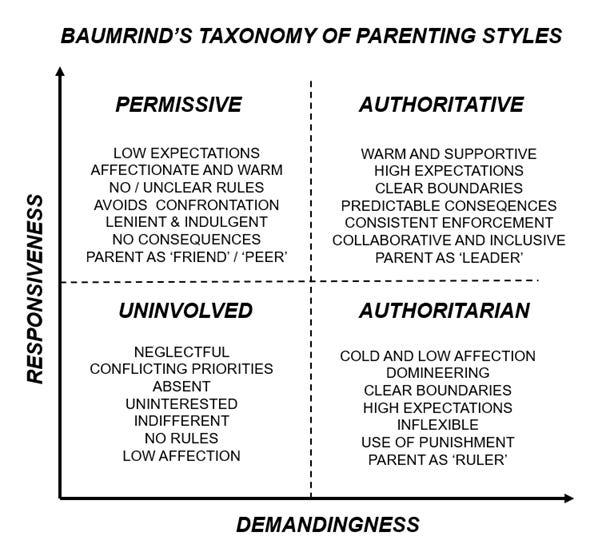
Baumrind originally grouped parenting into three styles: permissive, authoritative and authoritarian. Would it have killed her to come up with less similar names for the middle one and the strict one? I highly doubt it. She was not at all susceptible to death, only succumbing to a tragic car crash at the age of 91 (at which point she was still living independently, gardening and editing books). Out of respect, I will use the annoyingly similar names, and we’ll just have to stay focused. The fourth style, uninvolved or neglectful, was added later by psychologists who longed for a neat square. Arguably, it is not a ‘parenting style’ but simply an absence of parenting—so we’ll focus on the original three.
I’m sure many PhDs have since been written about the subcategories and qualifications to all these styles. I am also conscious that actual psychologists read this blog, so I am loath to oversimplify. But the original framework does the job for me: it’s detailed enough to give you a clear view of where you sit, or where you might wish to sit, but broad enough to account for family-to-family differences without splitting hairs. On paper, authoritative parenting is clearly the Goldilocks style: who wouldn’t want to be warm and supportive with good boundaries? In real life, lots of parents move within and between quadrants, depending on the situation or the day, accidentally or on purpose. The reasons for this are complex and real. Let’s dig in!
The patchy track record of authoritarian parenting
Low in responsiveness and high in demandingness, this parenting style is now mostly associated with old-timey, conservative, religious families in the Western world. The pop culture narrative would have us believe that children of authoritarian parents will fail to develop emotional competence, assertiveness, and self-confidence. Authoritarian parenting is also knocked for being counterproductive: it doesn’t teach kids morality, it just teaches them to avoid getting caught. And this style has ceased to be aspirational for many Western parents, regardless of its impact on children. While some elements of authoritarian parenting, like spanking, remain surprisingly popular (more so in the US than in Europe), parents generally want to have fun as a family, go on nice hikes, watch movies and enjoy a real connection, not make stilted small talk at the dinner table. For many parents, those ‘BECAUSE I SAY SO!’ authoritarian tendencies will only kick in with overwhelm, exhaustion or loss of self-control.

And there is persuasive evidence to show that children raised in authoritarian households are in fact more likely to experience a range of issues. Perhaps most surprisingly, they seem to perform a bit less well academically. The impact is statistically very small, but it does seem to suggest that the ‘Tiger Mum’ strategy of pushing children towards academic greatness isn’t all that effective. More predictably, authoritarian parenting increases the risk of anxiety, depression and lower self-esteem. Children and adolescents raised by authoritarian parents tend to be more fearful and have poorer social skills, which translates to fewer social interactions in early childhood. This makes complete sense to me: if parenting is mostly about modelling the right behaviour, authoritarian parents are simply… not modelling good social skills. Finally, this cohort of kids also has an elevated risk of alcohol and drug abuse. Again, pretty predictable: we’ve all known people who came from very buttoned-up families and inaugurated themselves into early adulthood by getting exponentially more shitfaced than everyone else around them.
At this point, the globally minded among you will be asking: what about the many Asian, African, Middle Eastern or Eastern European cultures, in which authoritarian parenting might be closer to the norm? Obviously, these regions aren’t just pumping out psychologically damaged people—and indeed, it seems that authoritarian parenting makes less of a dent in those cultures. The key here is that children’s outcomes are not driven by their parents’ words and actions per se, but rather by what those words and actions mean to children. Collectivist, family-first, hierarchical societies operate in reliance on a different social and emotional language. You obey your parents, but you may also see your dad greeting his mother-in-law by bowing down to touch her feet, and no one you know would dare to interrupt grandpa as he slowly tells the same story for the 11th time.
But even in the context of those collectivist cultures, authoritarian parenting still lags behind authoritative parenting. Some research has shown the association between negative parenting interactions and social anxiety might actually be stronger in East Asian families than Western families. Other studies from Indonesia and China have indicated that a more responsive parenting style can still be beneficial, while also challenging our cultural understanding of parental ‘warmth’, arguing that high-control parenting can still feel very warm, even if it doesn’t appear very warm to the Western eye. Ergo, some parenting practices that may superficially appear authoritarian to a Westerner might actually be authoritative—the Western observer just doesn’t speak the relevant love language.
Of course, one should never go full cultural relativist: I obviously don’t think that any parenting is fine, so long as everyone around you is doing it. Regardless of these findings, plenty of bad things, like sexism, body shaming, violence and homophobia, can co-exist with authoritative parenting. At the extreme end, the coming-of-age rituals for Simbari boys, which Aella describes in her characteristically mind-bending piece, are obviously abuse—even if they were they only thing the community knew. Nonetheless, it is worth saying that the psychological impact of a particular behaviour is not always clear to a Western observer.
This gets complicated when the ‘Western observer’ is… the child. Immigration may create intergenerational conflict when the child adopts local expectations, e.g. Western ideals relating to autonomy, emotional openness and parental warmth. For example, second-generation Asian American adolescents seem to experience a fair bit of conflict with their parents because of ‘parenting ideals that may not be culturally and socio-politically consonant with the child who is educated and raised entirely in the US’ (source). These difficulties presumably fade as the next generation of parent-and-child have more aligned ideas about family life. It’s worth noting that this is very tricky research to undertake, and any differences in children’s outcomes may be primarily caused by the socioeconomic challenges of immigration. But it makes sense to me that the mismatch between family parenting culture and local parenting culture could create statistically significant outcomes for children’s wellbeing, where the mismatch runs along the lines of warmth and control.
I am speculating here, but these findings can be extrapolated to include intergenerational cultural differences. The internet is full of older people shouting at younger parents to simply be tougher with their children. Reasoning? That’s how everyone was raised ‘back in the day’, and everyone is fine. As I’ve written before, I actually don’t think everyone is fine, but putting that to the side for one second, I don’t think this parenting style translates well into the modern Western world. Our parenting has generally become friendlier and less restrictive, and children of authoritarian parents are bound to wonder about the mismatch. I am not saying that we should keep going until we reach the lowest common denominator, but I am saying that it’s not fair to expect parents to speak a language their children won’t understand.
Overall, authoritarian parenting seems to break down under the weight of the evidence. It doesn’t even yield the best academic outcomes—so the whole ‘they might hate me now, but they will thank me later when they’re getting their PhD in Computer Science from MIT’ doesn’t even work. Authoritarianism does however increase the risk of poorer mental health outcomes, as well as failing to support children in developing to their potential socially. Even in hierarchical and collectivist cultures where respectful obedience is the norm, it still appears useful to be a bit more approachable and collaborative as a parent. Overall… rejected!
A brief history of permissive parenting
Permissive parenting is about being warm and not expecting much from your kids — specifically, not expecting them to listen to you or do what you want them to do. The parent is there to lovingly support from the sidelines while the child freely explores and develops on the pitch of life. Rousseau would no doubt have been an unapologetically permissive parent, had he not abandoned all five of his children at a foundling hospital right after birth (God bless him, it happens to the best of us). Today’s permissive parenting seems to come from three places: ideology, anxiety or overwhelm (or all of the above).

I’ll start by tackling the ideological underpinnings, which I believe to be more prevalent on the left of the political spectrum. At its core, leftwing ideology distrusts authority and hierarchy, generally viewing them as oppressive and illegitimately obtained. It therefore necessarily views power as oppressive and illegitimately obtained. Power becomes this strange thing you only half-claim whilst you are in the process of doing something ‘empowering’, so long as these activities never map onto acquiring any actual power. A boy born to a teen mum and abandoned by his alcoholic father, inspired by his Cuban stepfather to start a theatre troupe exploring issues in his local community? 100% empowering! Same boy founding the world’s largest e-commerce and cloud computing company? Go fuck yourself! No one on the left would ever call Jeff Bezos’s economic ascent ‘empowerment’, despite it resulting in an astronomical increase in personal power. I am not expressing any views about Amazon (though you can deduce them from my recent tirade against screens), but simply illustrating the left’s fraught relationship with actual power, which is not a feeling, but the ability to control your environment.
It is no wonder then that many left-leaning parents finds themselves at a loss as they cradle a whole new person over whom they have nearly complete power for some years to come. I am generalising, of course, but the right-coded response is to acknowledge this power and the immense responsibility that comes with it. The left-coded response is to find this power quite cringe and desperately deny it. The child is in charge, really, and I am but his large servant! Obviously, parents of all political stripes will joke about the newborn being ‘in charge’, just because the newborn’s needs are so humongous that meeting them necessitates a life-changing amount of work (even if the newborn is, in real terms, entirely powerless). Nonetheless, some parents still see themselves as the rightful leaders of their home. Others refuse to acknowledge the natural hierarchy of the nuclear family because hierarchies feel dumb and unjust.
And it’s true that some hierarchies have been dumb and unjust (e.g. hierarchy of the sexes or races, or even overly rigid workplace hierarchies). But imagine you are Kyle, a 23-year-old college graduate. You are on your way to visit your old roommate in his home city of Tokyo. You don’t speak or read Japanese, nor have you done any research on Tokyo. Your friend meets you at the airport with a suggested itinerary. You say: “Wait a second, Kazuki, I’ve actually got us covered based on general vibes and some truths that revealed themselves to me in a dream”. For the next three hours, Kazuki follows you around the airport as you search for the exit. Can we accept that it would have been wiser for Kazuki to lead? Guess what, I tricked you, you are Kazuki. Respectfully, children are Kyle. It’s not oppressive or illegitimate to recognise that children and parents (and, indeed, teachers) exist within an expertise-based relational hierarchy, necessitating that one person mostly leads and the other mostly follows.
The belief that adults and children should have equal power is pervasive and has yielded some pretty weird dynamics. When I was a teacher, I once called a mum to let her know that her daughter had stood up in the middle of my lesson, scanned my display board to identify any work written by girls she didn’t like, and proceeded to tear it to shreds. Upon hearing this complaint from me, the mum immediately consulted her daughter in the background before responding: ‘She says she didn’t rip any work off your wall’. Okay then, I guess I must have hallucinated in the middle of my lesson on ‘The Farmer’s Bride’ by Charlotte Mew. Without revealing more about this specific student, let me just say she had a tough time at school because she was always protected from the consequences of her own actions. Letting a child misbehave and then lie about it does not produce engaged and capable young adults ready to take on the world. It produces dysregulated, fragile and entitled people who sometimes struggle to relate to others (source).

The outcomes of permissive parenting are easy to predict. Without consistently enforced boundaries, children raised by permissive parents have poorer self-control and are more susceptible to anxiety (source)—turns out it’s actually quite stressful to exist within a flat-structure start-up environment when you’re 3 years old and have absolutely no idea what’s going on. Predictably, they also exhibit more selfish and aggressive behaviours, as these go unchallenged in the home which is the social ‘sandbox’ for children. It’s worth noting that these effects are small, i.e. there’s no evidence to suggest that permissive parenting is guaranteed to lead to a lifetime of anxiety and poor behaviour. But it’s important to flag these small impacts precisely because many parents choose the permissive style because they’re anxious to avoid negative behaviours and weakened mental health—and it just doesn’t work. Sensible rules are good for children.
Overwhelm is another driver of permissive parenting. One study from China found statistically significant negative effects on children’s social anxiety of parental burnout and permissive parenting. Clearly the ‘permissive parenting’ bit was not a choice, but a result of extreme parental stress caused by long working hours, lack of support and lack of sleep. There’s no point telling those parents to just ‘toughen up’. This is where policy bleeds into family—parents need better employment protections, including entitlement to flexible work where possible, and more policy support to lower the cost of living for families. Again, Dr. Becky’s ‘sturdy parenting scripts’ are not going to magically help to turn an exhausted, isolated parent into an energetic, authoritative figure who can lead children with ease. There’s only so much you can do when you’re running on fumes.
Just right: authoritative parenting
Finally, we get to Goldilocks parenting, which is highly responsive and warm, with clear boundaries, consistent enforcement and predictable consequences. Unlike the other two styles, it is not associated with any negative outcomes and it is consistently associated with the most positive outcomes: other things being equal, it seems to produce the most confident, resourceful, respectful, kind, socially competent and happy kids. It’s important to understand that this style beats all other styles at everything. For example, permissive parenting is associated with pretty good levels of confidence in children, which permissive parents seem to value. But authoritative parenting is associated with better levels of confidence (source). Similarly, authoritarian parents often believe that their disciplinarian ways will at least yield good academic results—and that’s true, but authoritative parenting is associated with better academic results (source). In short, you can argue that many of these impacts are too small to care about, but you can’t legitimately argue that permissive or authoritarian parenting styles are in any way better than authoritative parenting. Authoritative parenting takes the crown across all metrics (even if in some cases it’s a tiny crown).
The problem is that authoritative parenting can also be hard to pull off. There are lots of things that make it easier, like adequate rest, good energy levels, a lot of exposure to more experienced authoritative parents, a predictable family rhythm, an active and outdoorsy family lifestyle, supportive extended family, experience taking care of children before having your own, a mutually satisfactory division or outsourcing of household labour, and a good sense of humour. When parents are unable to access these things, it can be challenging not to slip into permissive or authoritarian parenting, simply because it is easier to let kids do whatever, or yell at them, or cycle between the two, than it is to work together to come up with a sensible way through the day.
Personalities also play a role. Some people are just more timid and less assertive than others. People seem to talk all the time about being too shy to assert themselves at work or in relationships. Many women, especially, speak of being socialised into ‘people pleasing’ and so on. I believe those women, though being from Poland, I did not get the memo. Like all of my compatriots, I am on a lifelong journey of learning how to keep my mouth shut. Back when Facebook groups were a thing, over 100,000 Polish people joined the New Year’s resolution group called “This Year I Will Finally Shut The Fuck Up”. But I digress. Clearly lots of people have some difficulty around assertiveness, conflict and confrontation—but I don’t think I’ve heard this issue discussed much in the context of parenting. Could it be that the person who is too shy to correct a colleague’s mistake will also experience some trepidation around telling their kid ‘no more berries for today’? Possibly!
Whatever the cause, it seems that a lot of parents end up concluding that their children are uniquely unmanageable. And while children do differ in temperament and risk appetite, there is little doubt that if you left any ‘challenging’ or ‘strong willed’ 7-year-old with the Maasai for three months, his behaviour would quickly become perfectly aligned with the expectations of the community, and upon your return you’d find him calmly tending to a goat. The challenge is not the child, but trying to reproduce the relevant conditions in a modern Western household. I know this is a tough pill to swallow for some people, but the probability that all the most challenging kids in the world have all been born in the last 15 years in English-speaking countries is 0%. More likely, the culture, the work-life balance, popular ideologies, and the average level of community and family support are not creating the right conditions to support healthy parental leadership.
I won’t be able to get through this article without mentioning the group of people who, completely unbeknownst to them, hold modern parenting discourse in a perma-chokehold: it is, of course, the hunter-gatherers. How did they do it? Elena Bridgers and Stephanie H. Murray who know more about this stuff than me have already written about this (here and here), but does appear that traditional societies got by just fine without behaviour charts, and in fact hardly disciplined children at all. While it’s hard to categorise this parenting style within a modern taxonomy, it would be wrong to call it ‘permissive’. I think it’s reasonable to assume our ancestors simply maintained a natural authority over their children as they visibly and competently provided shelter and food for everyone at all times. I am convinced that the boundaries set themselves because if you didn’t listen to your elders you quickly got hurt or died. Our ancestors also lived incredibly physically active and outdoor lives within tightknit communities, and children didn’t need to be squeezed into car seats and schools.
The natural ease of parenting in this context becomes abundantly clear as soon as you find yourself on something like a multi-family camping holiday. When the adults are working with their hands, fishing, collecting wood, pitching tents, and cooking food on a fire, children immediately become interested in two things: playing and ‘helping’ the adults. You don’t need to encourage a 7-year-old boy to help his dad chop wood. He wants nothing more than to wield an axe. Growing up, nobody had to offer me a sticker to motivate me to pick mushrooms and berries. I wanted to pick mushrooms and berries because I wanted to eat them, and I was also intrinsically motivated to pick the most in the group for my own personal satisfaction. There are no ‘bedtime battles’ if your day ends sitting around a fire in the dark, and everyone can just crawl into their sleeping bags and go to sleep whenever they feel like it. If this is indeed how we evolved, it makes complete sense that ‘parenting’ as we know it is a thoroughly modern invention.
But we live in a thoroughly modern world and most of us can only achieve the hunter-gatherer-adjacent lifestyle on holiday. I’m not going to complain about this, by the way. I thoroughly enjoy being literate and vaccinated against polio! But it is true that the way modern societies are structured does not automatically put you in the driver’s seat of your family. I don’t think we should feel particularly bad about it—but there are things we can all do to claw our way into that top right quadrant.
The practical bit: five things that make authoritative parenting easier
Trying not to work yourself into the ground this week
Sorry to start with a cliché one, but reading the studies about parental burnout and overwhelm made me very sad. Most people can only do so much about their working hours in this economy, but many of us also take on optional things that should never come at the cost of getting good sleep and a moment to rest. Having a tidy house, cooking from scratch and sending out this Substack on time have taken a back seat for me this month! I can think of so many times I’ve seen an exhausted parent do something completely superfluous when what they really needed was a nap.
Believing it should and will work
When I was struggling with behaviour management as a teacher, a much more experienced and effective colleague gave me this slightly mystical advice: when you ask them to do something, you have to believe that they should do it, and that they will do it. It actually works like magic. Teaching in a British school, I often found myself telling pupils to fix their tie, which—to be honest—I didn’t really care about at all, and didn’t expect them to care either. This sort of half-assed nagging is white noise to children. I then actually researched why uniforms have some real benefits to learning and observed how other teachers successfully did uniform checks. After that, my uniform-related requests suddenly became impactful. I can’t put my finger on what changed, except that I meant what I said. With so much of our communication being non-verbal, I think children just know when you mean it.
As a result, there’s little point trying to enforce rules you don’t care about. Sometimes I’ll feel like I should stop my son from doing something slightly annoying, but ultimately innocuous: let’s say I give him a piece of paper to draw on, but he starts to tear it into tiny pieces instead. In my heart of hearts, I know that I consigned that sheet of A4 to the recycling bin as soon as I gave it to my child and I don’t really care if it gets there in one piece or in 40 pieces. So I say nothing and continue to read my book. But I’ll immediately intervene and mean it when he’s chasing the dog with a screwdriver.
Creating co-ownership
Obviously I can’t write a post without once again asking everyone to get their children involved in chores and household activities. There are just too many benefits! One of them is that parents and children are working together towards the same goal and we all love to feel included. Honestly, if I went to work and everyone went to meetings and wrote emails and stuff, but put only me in the corner to watch cartoons, I would eventually be like: ‘Guys, sorry, but does everyone here think I’m fucking stupid?’ I wouldn’t enjoy it. Personally I want to be involved.

I think some people have seen children rush to press the elevator button and thought ‘Oh, cool, they like pressing buttons—let’s give them a toy with buttons!’ But it’s not about the buttons, it’s about helping your team get from A to B, in the one tiny way that’s available to you when you’re two years old. If a child has a meltdown because someone else pressed the button, they won’t be consoled by being handed another button to press. They wanted to press the button, the one that helps mum and dad get somewhere. Feeling useful reduces resistance and boosts cooperation. This is the human spirit and we ignore it at our own peril.
Retaining a sense of humour
We’re all here because children are hilarious, right? I’ve had some really low points as a teacher and as a mum, but kids also genuinely crack me up every day. One thing we lose when we try to regurgitate ‘parenting scripts’ is the ability to clown around in the moment. Lots of Mexican standoffs with toddlers can be diffused with a fart noise, and teenagers are genuinely so much easier to manage when you allow yourself to appreciate their unhinged sense of humour.
Always learning from more experienced parents
I chose to use a photo of the Netteburg family as the cover for this article because I love when people see something that’s generally considered ‘impossible’ to pull off with children and think ‘Nah, we’ll be fine’. They have five kids and the youngest was only two when the family completed the Pacific Crest Trail: that’s about six months of 20-mile days in bear country, mostly sleeping outdoors among wild animals and eating only what’s in your backpack—an absolutely amazing feat of parental leadership. Not everyone can be the Netteburgs, but there are so many incredible parents out there who have organised their family lives into something extraordinary. Before succumbing to a bad day and assuming I have the world’s most challenging child, I’ll always try to visualise what a more experienced and effective parent would do in my situation. Generally, outdoorsy communities are great for seeing some best practice, but being an urbanite I still get to observe amazing parenting all the time— and I certainly get to read all about it on this wretched platform. Thanks for reading.

I love how you turn attention to how hard it is to pull off authoritative parenting. Most parenting discourse talks about parenting styles as though it were primarily a matter of values or knowledge, as if parents who yell or give in are simply uninformed about better approaches. But parenting style is also, and perhaps very often, a resource problem. Authoritative parenting is cognitively and emotionally demanding, even with great resources, I'd say. The scaffolding itself is unevenly distributed in ways that map almost perfectly onto already existing inequalities. The parents with the least access to rest, support, predictable rhythms, and outsourcing household labour are disproportionately the ones already under the most financial and social pressure. I completely agree that talks about parenting styles should include material and social conditions that support or undermine it. Great writing, Dorota, you've done it again!
A fascinating topic!
I run How To Talk So Kids Will Listen workshops (a great authoritative framework), with international cohorts. My experience is that there is definitely a contingent of parents who are very uneasy with their own authority, but I don’t think it lines up with leftist politics, not for an international definition of leftist politics. I observed much more of a reaction to the parent’s personal story.
I also observed a fascinating linguistic phenomenon, which is an overrepresentation of permissive parenting among English speaking parents who self identify as “gentle parents”, in a way that isn’t found among parents natives of other languages following frameworks that ought to be similar on paper. I am convinced that the word “gentle” itself attracts a certain kind of person that balks at their own authority, in a way that benevolent or positive or authoritative or any number of other terms for “non coercive parenting” do not.